
Blog
FireChef Chef’s Cleaver: The Hand-Forged Serbian Cleaver Knife Built for Real Prep
Jul
Key takeaways
- Hand-forged, full-tang Serbian cleaver: blade and handle forged as one solid piece.
- 7 inch (18 cm) blade in 1095 high-carbon steel, hardened to HRC 60 and above for a keen, lasting edge.
- A true all-rounder for garlic, onions, herbs, steaks, large meat slabs and homemade biltong.
- Carbon steel is not stainless: wipe it dry, oil it lightly, and it lasts a lifetime.
- The favourite blade of YouTube’s Harry Fisher (Fire to Fork).
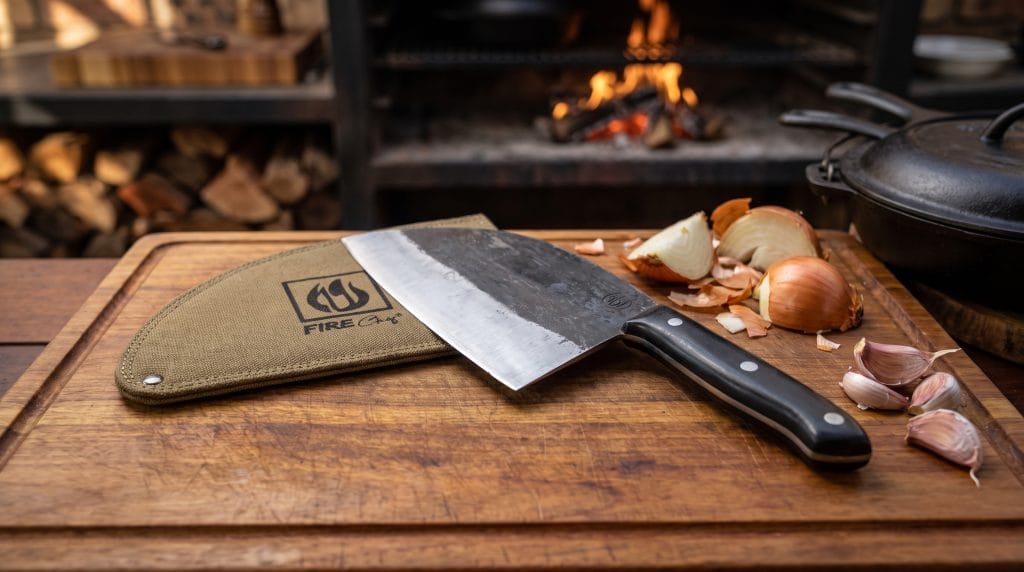
Pick up the FireChef Chef’s Cleaver once and the weight tells you everything. This is not a wafer-thin paring knife that skitters across an onion. It is a broad, purposeful slab of high-carbon steel that falls through a brown onion, powers through a large meat slab, and shaves biltong so thin you can read a recipe through it. In South African kitchens the Serbian cleaver has quietly become the one knife people reach for first, and it earns that spot at the prep board long before the fire is lit.
Key takeaways
- The FireChef Chef’s Cleaver is a hand-forged, full-tang Serbian-style cleaver: blade and handle forged as one solid piece for strength and balance.
- The 7 inch (18 cm) blade is 1095 high-carbon steel hardened to HRC 60 and above, so it takes a keen edge and holds it.
- It is a true all-rounder: garlic, onions, herbs, steaks, large meat slabs and homemade biltong all fall to the same knife.
- It is a meat cleaver, not a bone cleaver. The hard edge can chip on bone, so keep it for meat and vegetables.
- High-carbon steel is not stainless. Wipe it dry, oil it lightly, and it will outlast most knives in your drawer.
- It is the favourite blade of YouTube’s Harry Fisher (Fire to Fork), and a sensible first upgrade for anyone serious about prep.
What a Serbian cleaver actually is (and why cooks love it)
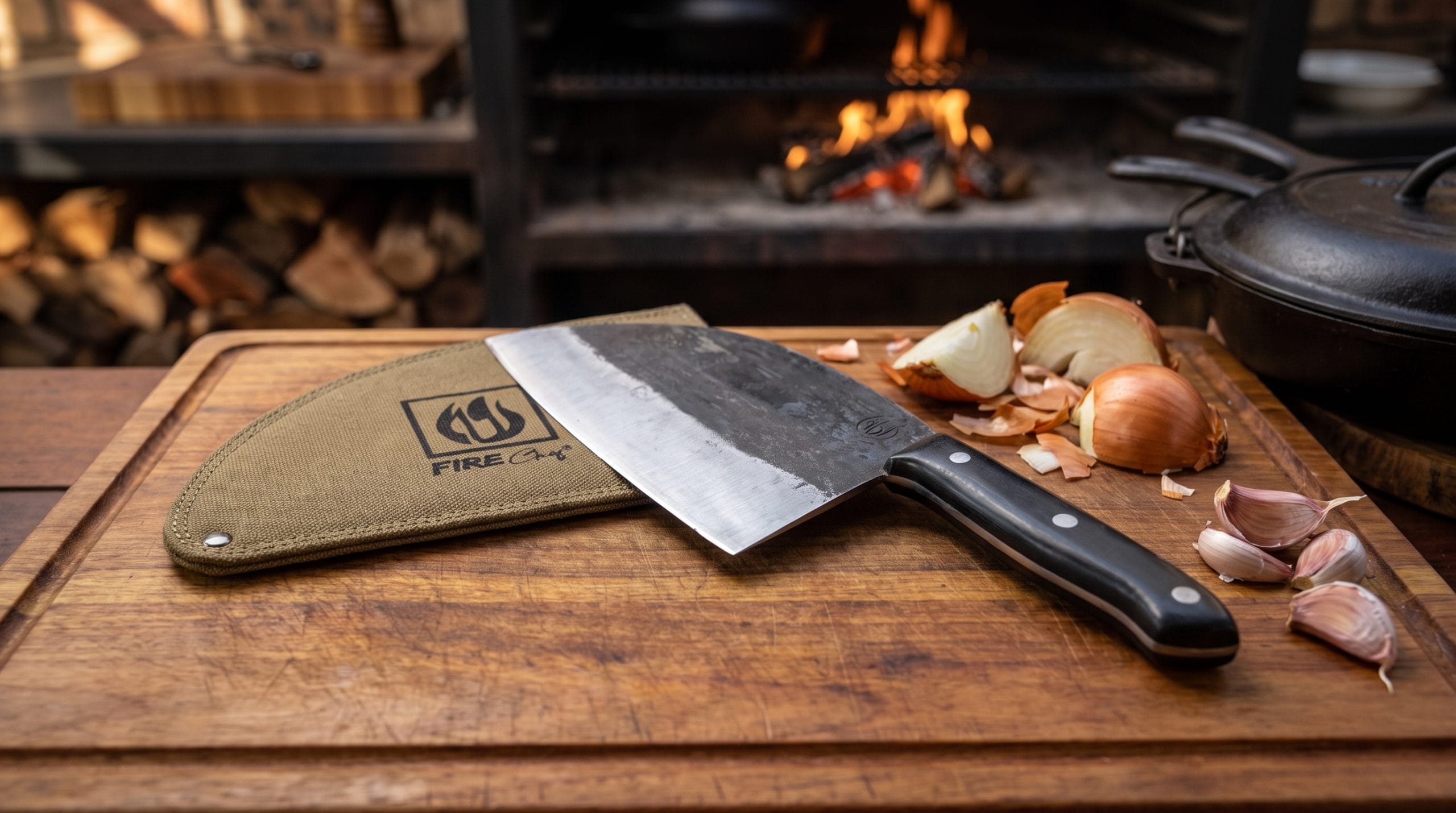
A Serbian cleaver is a broad-bladed chef’s knife that borrows the chopping authority of a butcher’s cleaver but keeps the finesse of a kitchen knife. The FireChef Chef’s Cleaver follows that tradition: a tall, flat blade with enough heft to power through dense work, and enough edge to handle delicate slicing. The design comes out of a blacksmithing lineage where knives were forged by hand rather than stamped from a sheet, and that heritage still shows in how these blades feel in use.
The tall blade does two useful things. The height gives your knuckles clearance above the board, which means you can chop for a long session without cramping, and the flat face doubles as a bench scraper to sweep chopped onion straight into the pot. It looks intimidating on the wall. In the hand it is calm, balanced and surprisingly nimble.
Why hand-forged, full-tang construction matters
Full-tang means the steel runs unbroken from the tip of the blade to the end of the handle, and on this cleaver the blade and handle are forged as one solid piece. That single-piece build is the difference between a knife that lasts a lifetime and one that works loose at the join after a few hard seasons. There is no glued-in tang to wobble, no hidden weak point where a partial tang stops short inside the handle. When you drive the blade through a thick slab of pork belly, the force travels through one continuous piece of steel.
The hardwood handle is shaped to sit in the palm rather than just fill it. That balance point, right where your grip meets the blade, is what lets you work quickly without fighting the knife. A cleaver this heavy could feel clumsy. Forged and balanced properly, it feels like an extension of your hand.
A brief word of care: a blade this capable is genuinely sharp and genuinely heavy. Cut on a stable board, keep your guiding hand in a claw with fingertips tucked back, and let the weight of the knife do the work rather than forcing it. Store it in a sheath or on a block, never loose in a drawer where a reaching hand can find the edge.
The steel: 1095 high-carbon, hardened to HRC 60+
The blade is 1095 high-carbon steel hardened to HRC 60 and above, and that is the heart of why it cuts so well. This cleaver uses a steel prized by traditional knife makers for a simple reason: high-carbon steel takes a keener edge than most stainless, holds a high polish, and is easy to bring back to razor sharpness on a stone. A harder blade at 60 HRC and above resists rolling and keeps its bite through a long prep session.
That hardness comes with one important limit: it makes the edge more brittle, so this is a meat cleaver, not a bone cleaver. Chopping through bones can chip the edge, so keep it to meat, vegetables and slicing work, and reach for a dedicated bone cleaver or saw when you need to go through bone.
There is another trade-off, and it is worth being honest about it. High-carbon steel is not stainless, so it will react with moisture, acids and salt if you leave it wet. In practice this is a five-second habit rather than a chore. Wipe the blade dry after cutting anything acidic like tomato, lemon or onion, and give it a light film of food-safe oil before it goes away. Over time the steel develops a soft grey patina, and that is not damage, it is a natural layer that actually helps protect the blade. Bright orange rust is the thing to avoid, and a dry blade never gets there.
From prep board to fire: what it handles
This is a genuine all-rounder, which is the whole point of owning one great knife instead of six average ones. It slices through garlic and onions, works through bunches of herbs, and portions the finest cuts of meat without tearing. It is just as at home carving a rested steak as it is knocking down a large meat slab into braai-ready portions. Keep it to meat and vegetables rather than bone, since the hard edge can chip on bone. If you make your own biltong, the flat blade and keen edge give you clean, even slices, thick for chewing or paper-thin for a platter.

Free recipe ebook
Get our free braai recipe ebook
Braai Time: South African recipes, techniques and cuts, sent straight to your inbox.
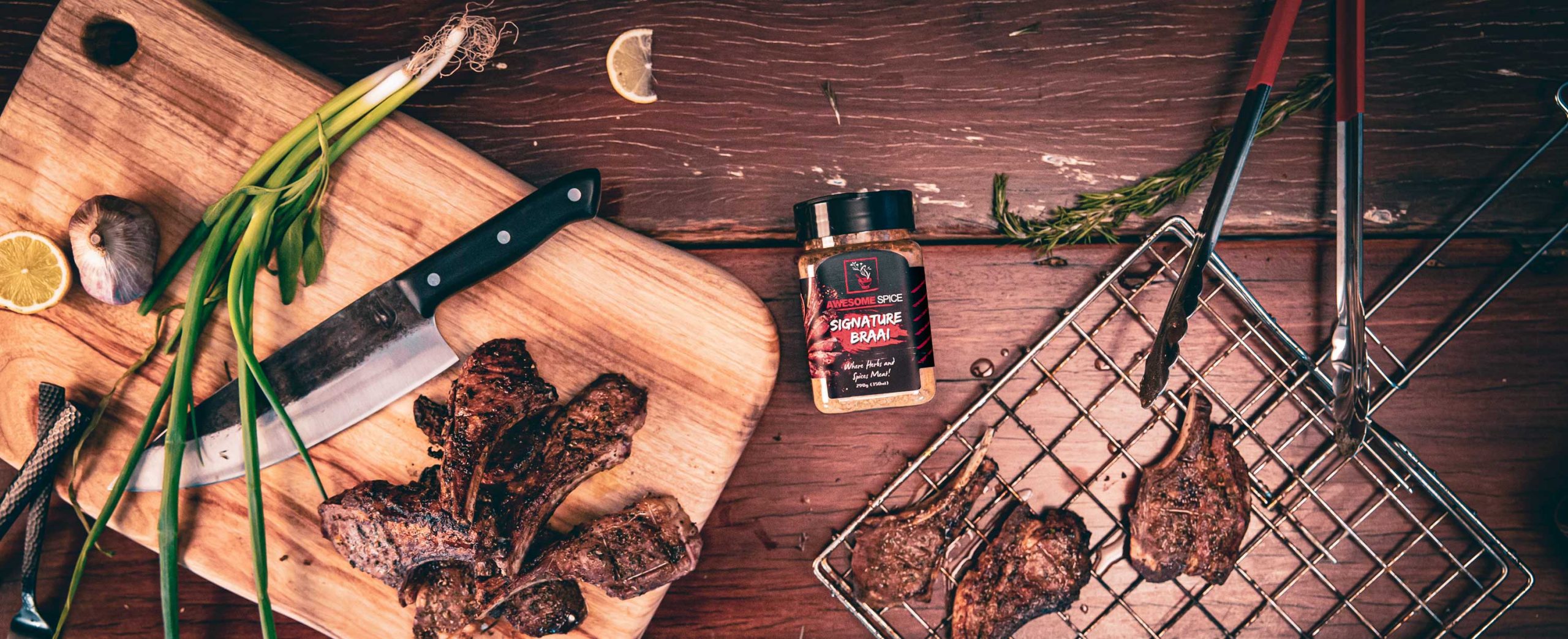
Put it to work on biltong steak with caramelised balsamic or on breaking down a whole picanha for Ricko’s picanha with chimichurri, and you understand why it earns permanent bench space. It is also the favourite blade of Harry Fisher of YouTube’s Fire to Fork, and it turns up in plenty of his top videos for exactly this reason: it does more jobs, better, than the drawer full of knives it replaces.
Raw-meat hygiene matters as much as knife skill here. Keep a separate board for raw meat, wash the blade and board in hot soapy water before they touch anything cooked, and dry the cleaver straight after so the carbon steel stays happy. A dedicated FireChef cutting board makes that routine easier and is kinder to the edge than glass or stone.
Keeping the edge (and the steel) in good order
Caring for a carbon-steel cleaver comes down to three habits: keep it dry, keep it oiled, and keep it sharp. Hand wash it, never the dishwasher, then dry it immediately. Every so often, or before longer storage, wipe the blade with a food-grade oil to hold moisture off the steel. Our food-grade mineral oil spray makes this a ten-second job, and the Carbon Steel Knife Maintenance Kit pulls the oil, cloth and sharpening basics into one place.
For the edge itself, a few passes on the FireChef Knife Sharpener 2.0 keeps it slicing cleanly. High-carbon steel rewards regular light maintenance far more than the occasional heavy grind, so a quick touch-up before a big cook beats waiting until the blade struggles. Always sharpen with the edge trailing away from your fingers, work slowly, and keep your steadying hand well clear of the blade path.
Who it is for
The FireChef Chef’s Cleaver suits anyone who does real volume at the board and wants one knife that can do most of it. If you are a passionate home cook, a braai host who preps for a crowd, or someone who makes biltong and breaks down larger cuts at home, this is the blade that quietly earns its keep. If you would rather build a full set at once, it also comes as part of the FireChef Knife Bundle, but honestly, most people start here and never look back.
Frequently asked questions
What is a Serbian cleaver used for?
A Serbian cleaver is an all-purpose kitchen knife used for slicing, chopping and prepping almost everything. Despite the cleaver shape, it is a meat cleaver rather than a bone cleaver, so it is not made for chopping through bones. The hard, keen edge can chip on bone. The FireChef version handles garlic and onions, herbs, fine cuts of meat, large meat slabs and homemade biltong, so it replaces several knives with one.
Is a cleaver knife better than a chef’s knife?
It depends on your work, but a Serbian cleaver gives you more chopping power and knuckle clearance than a standard chef’s knife while still slicing finely. Heavy prep, dense vegetables and portioning meat all suit the cleaver. For very delicate, precise tasks some cooks still like a smaller blade, which is why many keep both.
Is 1095 high-carbon steel good for a knife?
Yes. 1095 high-carbon steel takes a very keen edge, holds it well and is easy to resharpen on a stone. The trade-off is that it is not stainless, so it needs to be kept dry and lightly oiled. Look after it and it will outperform and outlast most stainless knives.
How do I stop my carbon steel cleaver from rusting?
Keep it dry and lightly oiled. Wipe the blade after cutting anything acidic, hand wash and dry it straight away, and give it a thin film of food-grade oil before storage. A soft grey patina is normal and protective. Only bright orange rust is a problem, and a dry blade avoids it.
Shop the gear
Start with the FireChef Chef’s Cleaver, keep it in top form with the Carbon Steel Knife Maintenance Kit and food-grade mineral oil, and give it a proper surface to work on with the Premium FireChef Cutting Boards.