
Blog
How to Check Fire Conditions and Light a Fire Safely While Travelling
Jun
Key takeaways
- Check both the fire danger rating and the total fire ban status on www.fireban.com.au for your exact destination before lighting, the night before and again that morning.
- The AFDRS has four levels (Moderate, High, Extreme, Catastrophic); Extreme and Catastrophic days are not for open-flame cooking in the bush.
- Light small and clean with tinder, kindling then hardwood, and never use petrol or lighter fluid.
- A fire is only out when the coals are cold to the touch: drown, stir and repeat until there is no hiss, steam or warmth.
- Never bury coals, especially on the beach, where buried heat can burn a barefoot child hours later.
Before you strike a single match, check two things: the fire danger rating for the area you are heading to, and whether a total fire ban is in force that day. The rating tells you how a bushfire would behave if one started, and the ban tells you whether you are legally allowed to light up at all. Both can change overnight, and both can differ from the town you left that morning. Get into the habit of checking the night before and again on the morning you plan to cook, because conditions in the Australian bush move fast.
This is the part of camp cooking nobody romanticises, and it is the part that matters most. A good fire is easy once you know the cues. Doing it safely, and leaving nothing dangerous behind, is the real skill. Here is how to read the conditions, light cleanly, and pack up so the next person (and the next kid running down the beach) never knows you were there.
Check the fire danger rating and ban status first
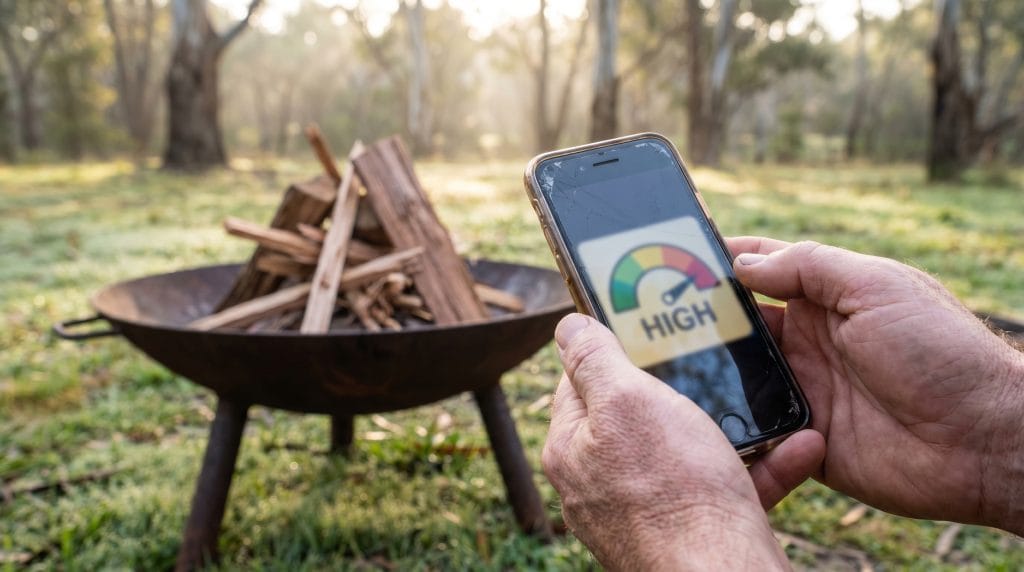
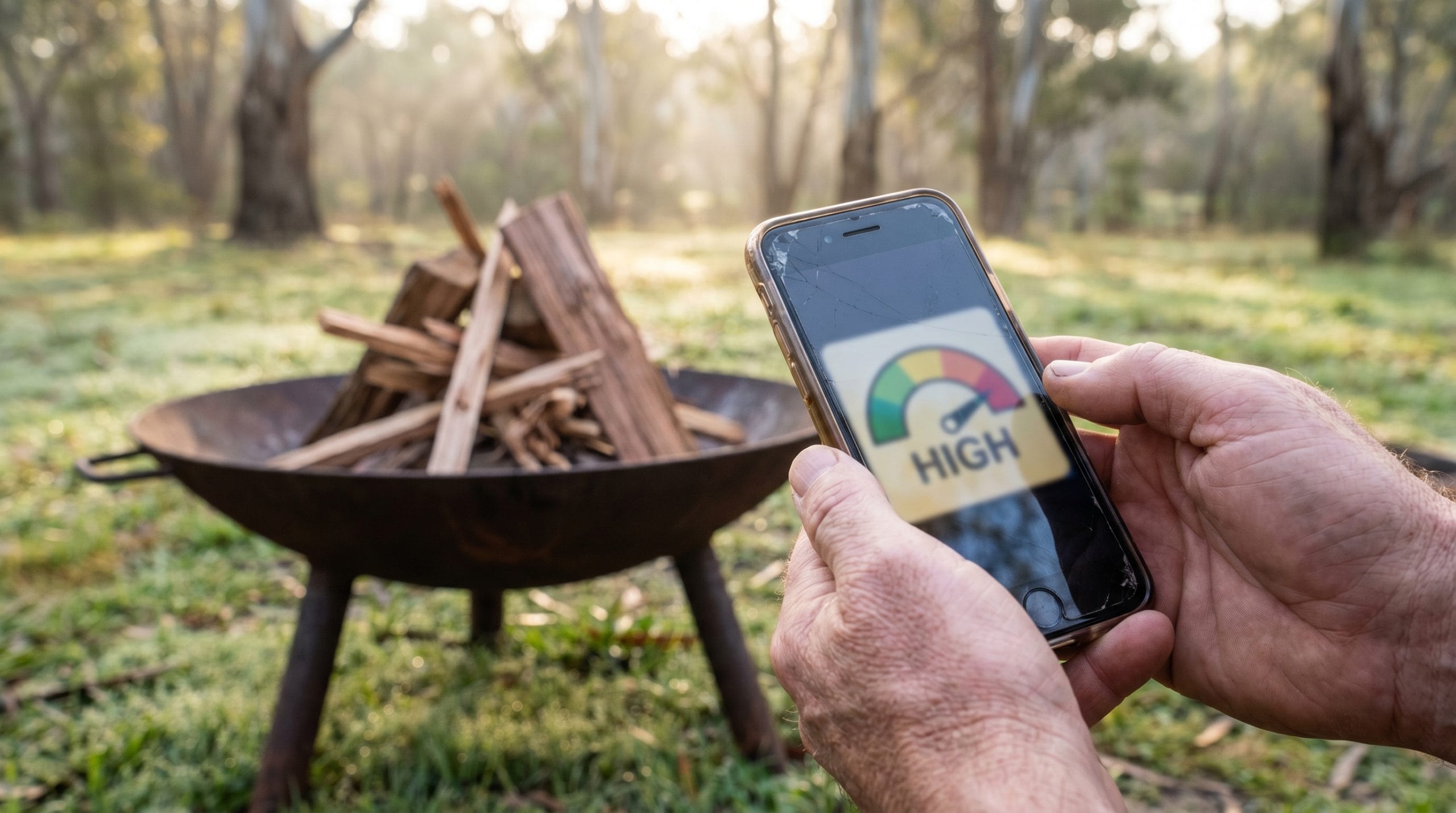
Always check the official fire danger rating and ban status for your exact location before lighting any fire. Since 1 September 2022, Australia has used a single national system. The Australian Fire Danger Rating System (AFDRS) uses four action-oriented levels designed to tell you how serious a fire would be if one started.
The four levels are Moderate, High, Extreme and Catastrophic, plus a white “No Rating” band for days when no proactive action is needed. It is worth understanding what they actually mean, because the rating describes consequences, not the chance of a fire starting.
- Moderate (and No Rating): Plan and prepare. Most fires can be controlled. This is your normal, sensible-camping zone.
- High: Be ready to act. Fires that start can be dangerous. Watch the wind and keep your fire small.
- Extreme: Take action now to protect life and property. Fires will spread fast and be hard to control. This is not a day to be cooking over open flame in the bush.
- Catastrophic: The most dangerous conditions. If a fire starts and takes hold, lives are likely to be lost. The honest answer here is do not light anything, and reconsider being in a bushfire risk area at all.
The rating is forecast daily by the Bureau of Meteorology and shown the same way across every state, so it reads identically whether you are in the Flinders Ranges or far north Queensland. You can check current ratings and ban information for where you are travelling at fireban.com.au or directly through your state fire service.
Understand what a total fire ban actually stops you doing
A total fire ban is a legal restriction, separate from the danger rating, and on those days lighting an open fire in the open air is generally prohibited. The catch for travellers is that the rules around solid-fuel barbecues, wood, charcoal and even gas vary between states and even between council areas. What is fine in one campground can carry a serious fine a few hundred kilometres up the road.
Because the detail differs by state and changes with the season, do not rely on memory or on what was allowed last trip. Check the current rules for the specific state and park you are visiting on the day. As a general rule of thumb when a total fire ban is declared: open wood and charcoal fires are usually out, many solid-fuel barbecues are restricted, and a permanent gas barbecue in a designated area is more often allowed, but only with conditions. When in doubt, treat the answer as no and cook on gas or eat cold. A fine is the small risk. Starting a bushfire is the one you cannot take back.
Also look for local signage. National parks, state forests and many free camps post their own fire rules at the gate, including seasonal closures and designated fireplace-only zones. Those signs override your plans.
Pick the right spot before you light
Choose a site with bare earth or an existing fire ring, well clear of overhanging branches, dry grass and your tent. A campfire needs a buffer of cleared ground around it, ideally three metres of bare mineral soil with nothing flammable hanging above. If there is a provided fire ring or fireplace, use it rather than scarring a new patch of ground.
Read the wind before you commit. A steady breeze carries embers further than people expect, so position yourself so smoke and sparks blow away from your tent, your vehicle and any bush. If the wind is gusty and strong, that is your cue to keep the fire very small or skip it altogether. Keep a bucket of water or a few litres in a container within arm’s reach the whole time, not back at the car.
A contained steel braai makes all of this easier, because the fire sits off the ground in a defined box instead of spreading across open soil. A Compact Braai or Mini Braai keeps your coals in one place, lifts the heat off the grass, and packs down flat for the next leg of the trip.
Light a clean fire, step by step
Build small and let it grow. A clean fire starts with dry tinder, builds through kindling, and only then takes larger wood. Rushing to big logs is how you end up with a smoky, sulking pile that you are tempted to splash fuel on, and lighter fluid or petrol on an open fire is genuinely dangerous: the vapour can flash back. Don’t do it.
- Lay your base: A small handful of dry tinder (fine bark, dry grass, paper or purpose-made tinder) in the centre.
- Build the kindling: Stack pencil-thin then thumb-thick dry sticks in a loose teepee or lean-to so air can move through. Fire needs oxygen more than it needs more fuel.
- Light low and upwind: Set the flame to the base on the side the breeze is coming from. A wind-resistant lighter earns its place here. Keep your hand clear as the tinder catches, because flames climb a teepee quickly.
- Feed gradually: Add kindling as the flames take, then move to split hardwood once you have a steady burn. Good local hardwood gives you long, even heat and clean coals.
- Burn down to coals for cooking: For braai, you are not cooking over flames. Let the wood burn down to a bed of glowing, ash-grey coals, which usually takes 30 to 45 minutes depending on the wood.
If you are cooking on charcoal rather than wood, a chimney starter is the fastest, cleanest way to get going without fuel or fuss. Fill a Charcoal Chimney, light it from the bottom, and you will have evenly lit coals in 15 to 20 minutes. Tip them out with care, because the chimney itself stays scorching hot for a long while: heatproof gloves are not optional. A pair of Extreme Heat Gloves save knuckles and nerves. A Fire Blower lets you coax a flame back to life without leaning your face into the heat.
To judge cooking heat, hold your hand a safe distance above the grid at cooking height. If you can hold it there for only two to three seconds before it is uncomfortable, you have a hot fire; four to five seconds is medium. Pull your hand away the moment it stops being comfortable. Never test heat by touching the metal.
Free recipe ebook
Get our free braai recipe ebook
Braai Time: South African recipes, techniques and cuts, sent straight to your inbox.
Put it out properly, every time
A fire is only out when the coals are cold to the touch, not just grey on top. This is the step people skip when they are tired, packing up in the dark, or keen to get on the road, and it is exactly how campfires reignite hours later. Heat hides deep in a coal bed and a light breeze can fan it back to life long after you have driven off.
Do it in this order, and give it time:
- Drown it: If it is a fire on the ground, pour water generously over the coals, not just a splash. Expect a lot of steam, so stand back and keep your face clear.
- Stir: Use a stick or spade to turn the coals and ash, exposing the buried embers, then pour more water through.
- Repeat until silent: Keep going until there is no hissing, no steam and no warmth rising. If it still hisses, it is still alive.
- Feel for heat: Hold the back of your hand just above the bed. If you feel any warmth, it is not done. Only when it is cold is the fire actually out.
If you are genuinely short of water, smothering with soil can help, but it is a poor second to drowning because coals can smoulder under sand or dirt for hours. Water is always the better tool. Plan your water so you have enough left to extinguish, not just to cook and drink.
Leave no dangerous coals behind
Never bury hot or warm coals, and never leave a fire unattended, even briefly. Buried coals are the hidden hazard of bush and beach camping. Sand and soil insulate heat rather than killing it, so a coal bed covered over can stay hot enough to cause a deep burn many hours later, long after it looks dead and cold on the surface.
On the beach this is a particular danger. A child running barefoot across the sand has no way of knowing a buried fire is there, and burns from buried beach coals are severe and sadly not rare. So the rule is simple: never bury your coals on the beach or anywhere else. Drown them cold, then scatter or pack them out.
Here is how to leave a clean site:
- Cook in a contained braai where you can: It keeps coals off the ground and makes cleanup a matter of tipping out cold ash rather than scarring the earth.
- Wait for coals to be fully cold before you touch or move anything.
- Scatter the cold, ash widely over bare ground, or bag it and pack it out where bins or rules require it. Cold is the non-negotiable part.
- Carry your rubbish out: Foil, bottle caps and bones do not burn away. Leave the site cleaner than you found it.
- Check the ground before you drive off: Walk a slow circle, hand low over where the fire was, feeling for any rising heat.
It takes ten extra minutes. It is the difference between a clean trip and a bushfire, or a burns ward, with your name on it.
Frequently asked questions
Can I have a campfire on a total fire ban day? Generally no. On a total fire ban day, lighting a fire in the open is usually prohibited, and many solid-fuel barbecues are restricted too. The exact rules vary by state and even by council, so check the current restrictions for the specific area before you light anything. When unsure, cook on gas in a designated area or go without. – Check www.fireban.com.au
What is the difference between a fire danger rating and a total fire ban? The fire danger rating (Moderate, High, Extreme or Catastrophic) describes how dangerous a bushfire would be if one started. A total fire ban is a separate legal restriction on lighting fires, declared on high-risk days. You can have a ban without a Catastrophic rating, so always check both.
How long does it take coals to go cold? Left alone, a coal bed can stay hot for many hours, sometimes more than a day under sand or soil. Drowned and stirred with plenty of water, coals can be cold to the touch in a few minutes. Always confirm by feel before you leave, never by appearance.
Why should I never bury coals on the beach? Because sand traps heat instead of cooling it, and buried coals can stay hot enough to cause serious burns for hours. A child walking barefoot cannot see the danger. Drown your coals cold with water and scatter or pack them out instead.
Is it safe to use petrol or lighter fluid to start a fire? No. Liquid accelerants can flash back to the container and the vapour can ignite without warning. Use dry tinder, kindling and a wind-resistant lighter or a chimney starter instead.
Cook well, travel clean
The campers who never have a scare are not lucky, they are methodical. They check the rating and the ban before they go, they light small and clean, and they treat putting the fire out as part of the cook, not an afterthought. Do that every time and the fire stays a pleasure rather than a risk. Then the only thing you leave behind is the smell of a good feed, like a camp braai potjie simmered down over the coals, or a breakfast braaibroodjie to send you up the road.
Shop the gear: the Travel Braai and Camp Braai keep your fire contained and off the ground, while a Charcoal Chimney, Fire Blower and a pair of Extreme Heat Gloves make lighting and handling coals safe and simple.